

Greetings from the South Asia Collective! We are a network of human rights activists and organisations from across South Asia. We’ve been working since 2015 to document the condition of the region’s minorities, and to help develop capacity among grassroots-level organisations focused on minority rights and the freedom of religion or belief (FoRB).

We are pleased to bring to you the 11th edition (2024/1) of our Online Bulletin, where we provide an overview of recent human rights violations against South Asia’s minorities, and other minority-related news developments. This edition covers the period between January and May, 2024.
Our bulletins are put together by research and documentation team from Afghanistan, Bangladesh, India, Myanmar, Nepal, Pakistan and Sri Lanka.
We have been reporting on developments related to key rights enshrined in International Human Rights Law, encompassing civil & political rights, as well as economic, social, & cultural rights, and closely monitor the various abuses and violations against minorities in South Asia. Our reporting and presentation will be guided by IHRL.
While our primary focus is on religious minorities (and micro-minorities), our teams will also cover ethnic, caste, gender, and sexual minorities, as well as indigenous peoples. The Bulletins utilise mostly secondary sources of data. These include international and domestic media outlets, as well as other civil society-led documentation efforts. Occasionally we use primary sources, using interviews with victim, witnesses, and other relevant individuals. Although updates from these sources undergo internal verification, we do not disclose their details due to security reasons.
In a region where the bulk of targeted violence incidents go unreported, our Bulletins are not intended to provide an exhaustive list of violations. Our aim is to establish a record, highlight trends, and contribute to processes aimed at awareness, prevention, and accountability.
Previous bulletins are available here
Highlights of the period under review
Links to country sections: Afghanistan | Bangladesh | India | Myanmar | Nepal | Pakistan | Sri Lanka
Highlights of the period under review
During the period under review, vulnerable minority groups such as Ahmadiyyas (Pakistan), Christians (India, Nepal, Pakistan, Sri Lanka), Dalits (India, Nepal), Rohingyas (Myanmar), Hindus (Pakistan, Bangladesh), Muslims (India and Sri Lanka), and Shia Muslims (Afghanistan) faced ongoing discrimination and marginalisation. Following are the highlights from the period under review.
Physical integrity rights
The Hazara and Shia minorities in Afghanistan were subjected to targeted violence, including bombings and gun attacks. India’s Muslims were victims of state-sponsored violence against them, as reflected in several cases of arbitrary detentions, extra-judicial killings, summary demolitions of property as collective punishment. An already serious humanitarian crisis in Myanmar was made worse by ongoing clash between the military and resistance forces, with civilian deaths and arbitrary detentions. Rohingyas and other ethnic minorities suffered disproportionately. Deeply rooted societal preconceptions are reflected in Nepal’s ongoing discrimination against Dalits, particularly in the form of legal and social hurdles to intercaste marriages. Several instances of mob violence and torture against religious minorities were reported from Pakistan. In Sri Lanka, continuation of police brutality towards the Tamil minority and lack of accountability for enforced disappearances were reported.
Hate speech
During the period of review, there have been several reports of hate speech from India. Prime Minister Narendra Modi and other senior BJP officials used divisive language during the general election, violating election laws. They were reported to have called Muslims in India as “infiltrators” and accusing the opposition of plotting to transfer properties from Hindus to Muslims. Furthermore, there have been 25 instances of “top level” hate speech by BJP officials, including incendiary remarks that ignited violence against Muslims.
Individual liberties
Violation of right to religious freedom were reported from Afghanistan, Bangladesh, India, Nepal, Pakistan, and Sri Lanka. These included allegations of forced conversion targeting Shia and Ismaili communities in Afghanistan; violent attacks on Hindu temples in Bangladesh, and Indian Prime minister’s dedication of a Hindu temple in Ayodhya (Uttar Pradesh) on the ruins of a destroyed mosque, and restrictions on Muslim and Christian religious practices. Restrictions on religious activities of religious minorities, including ban on (Christian) proselytisation in Nepal, and a restricted space for religious practice of Ahmadiyya community and other religious minorities in Pakistan, besides conditional access to temples in Sri Lanka are some of the instances of the restrictions. Reports of violation of freedom of speech and expression were reported from Afghanistan (imposition of Pashto language in Persian-speaking regions), India (continuing denials of basic freedoms in Muslim majority Indian Administered Kashmir), Myanmar (detention targeting activist and right defenders), and Sri Lanka (threats over an article). Additionally, the exclusion of minority groups, such as Hindus in Pakistan from the electoral process and targeting of right to universal suffrage of Muslims in India, reflect broader challenges to political participation and representation, perpetuating issues of marginalisation and discrimination.
Discrimination in access to economic, social and cultural rights
During the period of review, instances like refusal to provide identity cards to members of the Sadat ethnic minority and prohibition of sale on literatures about Shia Muslims were reported from Afghanistan. Similarly, arbitrary demolition of Muslim homes as collective punishment in India, documented seizure of civilian’s property in Myanmar, and persistence of haruwa charuwa system of bonded labour in Nepal, disproportionately affecting Dalit minorities were reported.
Positive developments
Hosting its first international LGBTQIA+ tourism conference and landmark rulings in LGBTQIA+ rights, Nepal has been able to set positive example for nations striving to promote LGBTQIA+ rights.
This bulletin highlights the disturbing trend of ongoing marginalisation and discrimination across the region. While documenting the challenges faced by minorities, the bulletin has also celebrated the progress and legal victories that signify progress towards justice and inclusivity.
Other announcements
The 2024 edition of SAC’s flagship annual South Asia State of Minorities (SASoM) Report, will examine Representation and Participation of Minorities in South Asia: Political, Economic and Social. The report will contain chapters from Afghanistan, Bangladesh, India, Myanmar, Nepal, Pakistan, and Sri Lanka. Ahead of the launch of the report, scheduled for February 2024, SAC is exploring interventions focusing on justice and accountability on one hand, and promoting dialogue and diversity on the other. Organisations and individuals seeking to collaborate with us towards these efforts are requested to email us at sac@thesouthasiacollective.org with suggestions and proposals.
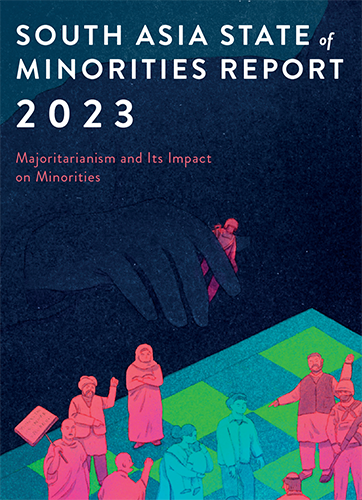
The 2023 edition of the SASoM Report remains available for free download here. The recording of the launch event is available here. The report focused on Majoritarianism and its impact on South Asian minorities.
 Recently, SAC made a submission to the UN Special Rapporteur (SR) on institutional mechanism by state for minorities. The submission, which was made in response to a call for inputs ahead of the SR’s report to the General Assembly, covers Afghanistan, Bangladesh, India, Myanmar, Nepal, Pakistan, and Sri Lanka. SAC’s inputs are available here.
Recently, SAC member Sudeshna Thapa was invited to discuss on the shadow of majoritarianism in Nepal in a podcast hosted by Policy Entrepreneur Inc. Nepal. Tune in to the podcast here.
Happy reading!
The South Asia Collective team